
If you’ve ever sat across the table from me in my small office off Peachtree Street, you already know I don’t sugarcoat things. A Blank Bill of Sale Georgia isn’t just a form — it’s the document that can protect you, or expose you, in ways most people don’t realize. After handling countless private-party sales, title problems, and those last-minute DMV surprises that ruin people’s mornings, I’ve learned that this one sheet of paper often decides whether a transaction goes smoothly or turns into a headache.
I’m Dale Preiser, a Georgia lawyer who’s spent years helping folks sort out vehicle transfers, disputed ownership claims, and situations where a simple bill of sale could have prevented a lot of frustration. And for anyone new to the process, a Blank Bill of Sale Georgia is basically the written proof of a deal — who sold what, to whom, when, and in what condition. It’s simple on paper, but in real life it can save you from liability, fines, or being dragged into someone else’s mess.
So let me walk you through how I approach a blank Georgia bill of sale — the way I explain it to clients in my office, not the way a textbook does.
Last Updated: October 1, 2026
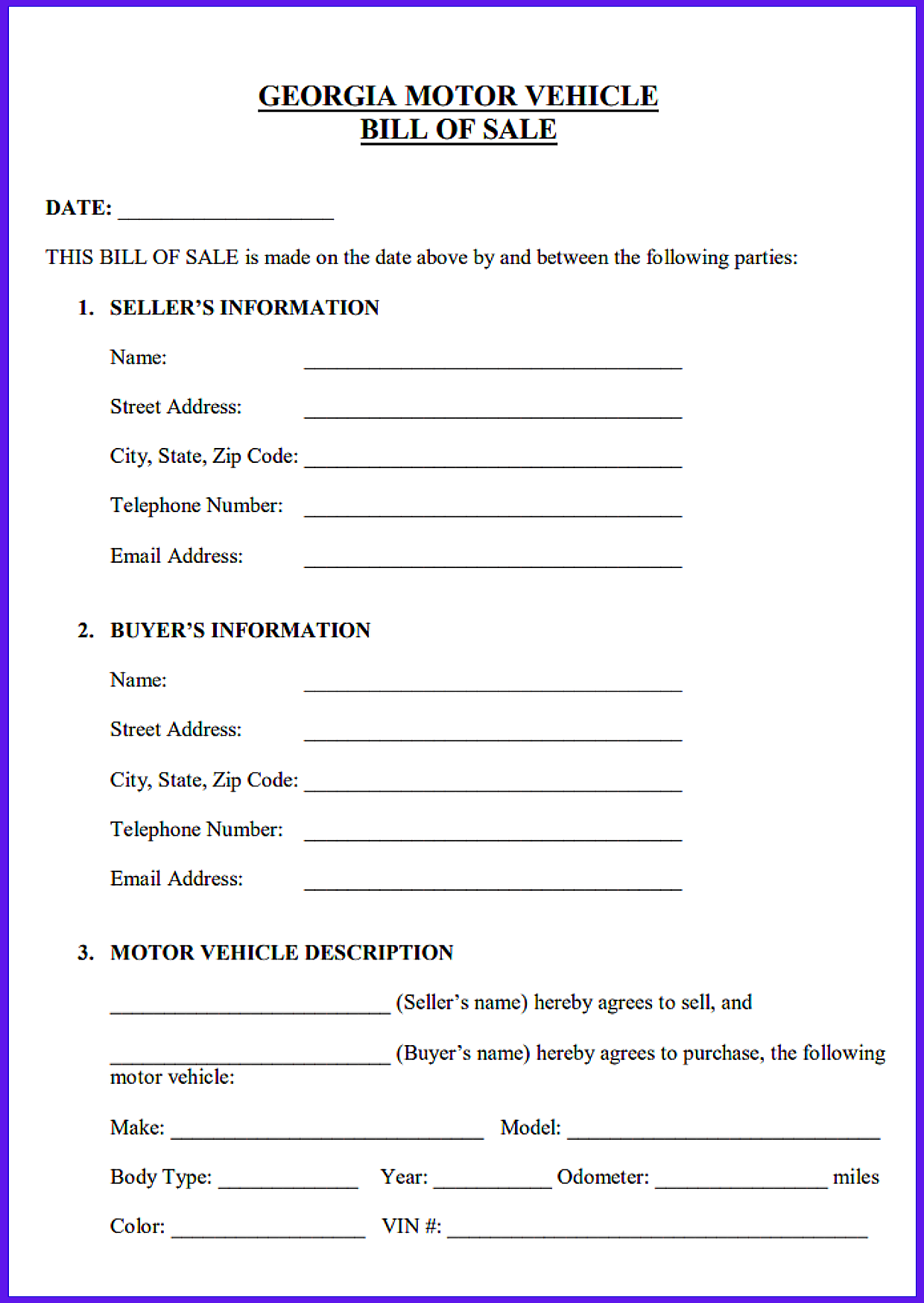
Free Printable Blank Bill of Sale Georgia Template

There’s something reassuring about starting with a clean template, especially when you’re dealing with a Georgia sale that needs to be documented correctly. I’ve had clients walk into my office with handwritten notes, half-filled receipts, and even text message screenshots. None of those hold up like a proper, well-structured blank bill of sale. When someone needs a dependable starting point, I always guide them toward a clean printable version so every detail gets recorded the way Georgia likes it.
A printable blank bill of sale helps avoid the “did we forget something?” panic that hits people at the DMV counter. It lays out the buyer’s information, the seller’s information, the vehicle or property details, and those crucial statements that protect both sides. And if you prefer something you can quickly print or edit, I usually provide it in both formats — PDF for easy printing and Word for simple editing, whichever fits your workflow better.
Georgia Blank Bill of Sale Rules Most People Never Read Until Something Goes Wrong
| Topic / Issue | Georgia Legal Rule | Governing Statute |
|---|---|---|
| Controlling Law | General personal property sales and transfers in Georgia are governed under Georgia Uniform Commercial Code sales laws. | O.C.G.A. Title 11, Article 2 |
| Statute of Frauds | A written contract or formal bill of sale is legally required for transactions involving goods valued at $500 or more. | O.C.G.A. § 11-2-201 |
| Execution Formalities | Georgia does not require witnesses for a general bill of sale. Buyer and seller signatures are sufficient for enforcement. | No statutory requirement; governed by general contract law. |
| Notary Public Requirements | Georgia does not require notarization for a generic personal property bill of sale. | No statutory requirement; governed by general contract law. |
| Electronic Execution | Electronic signatures and digital bill of sale documents are legally valid and enforceable in Georgia. | O.C.G.A. § 10-12-1 et seq. (Georgia Uniform Electronic Transactions Act) |
| Transfer of Ownership | Unless otherwise agreed in writing, ownership transfers to the buyer when the seller physically delivers the goods. | O.C.G.A. § 11-2-401 |
| “As-Is” Warranty Disclaimer | Sellers must use clear “AS IS” or “WITH ALL FAULTS” language to exclude implied warranties. | O.C.G.A. § 11-2-316(3)(a) |
| Private Record Keeping | A blank bill of sale for personal property is treated as a private contract and receipt between the parties. | No filing requirement provided. |
| Filing Exemptions | Georgia does not require general personal property bills of sale to be filed with the Department of Revenue, Division of Corporations, or county offices. | No filing requirement provided. |
| Inability to Pass Stolen Title | A bill of sale cannot legally transfer ownership of stolen property or property held with void title. | O.C.G.A. § 11-2-403 |
| Unconscionable Contracts and Clauses | Georgia courts may refuse to enforce bill of sale contracts or clauses considered unconscionable or oppressive. | O.C.G.A. § 11-2-302 |
| Felony Falsification of Material Facts | Knowingly falsifying transaction details, identities, dates, or purchase prices on a bill of sale may constitute a felony offense. | O.C.G.A. § 16-10-20 |
One of the most important Georgia rules people overlook is that a bill of sale becomes legally critical once the property involved is worth $500 or more. At that point, Georgia law requires a written agreement to enforce the transaction properly. That means a casual text message or verbal handshake may not protect you when disputes appear later.
Another surprisingly important rule involves ownership itself. A bill of sale cannot magically create valid ownership if the seller never legally owned the property in the first place. I’ve seen buyers shocked to learn that even a signed document will not protect them if the item turns out to be stolen property or tied to fraudulent ownership claims.
The electronic signature rule also matters more than people realize today. Georgia courts recognize digital bill of sale agreements as legally enforceable, which helps buyers and sellers complete transactions remotely without losing legal protection.
The biggest mistake, though, is falsifying information. Changing dates, sale prices, or party identities to avoid taxes or hide financial activity can cross into felony territory under Georgia law, carrying potential prison exposure.
To avoid costly ownership disputes and paperwork problems, download the free Georgia Blank Bill of Sale template and document your transaction properly from the beginning.
Blank Auto Bill of Sale Georgia
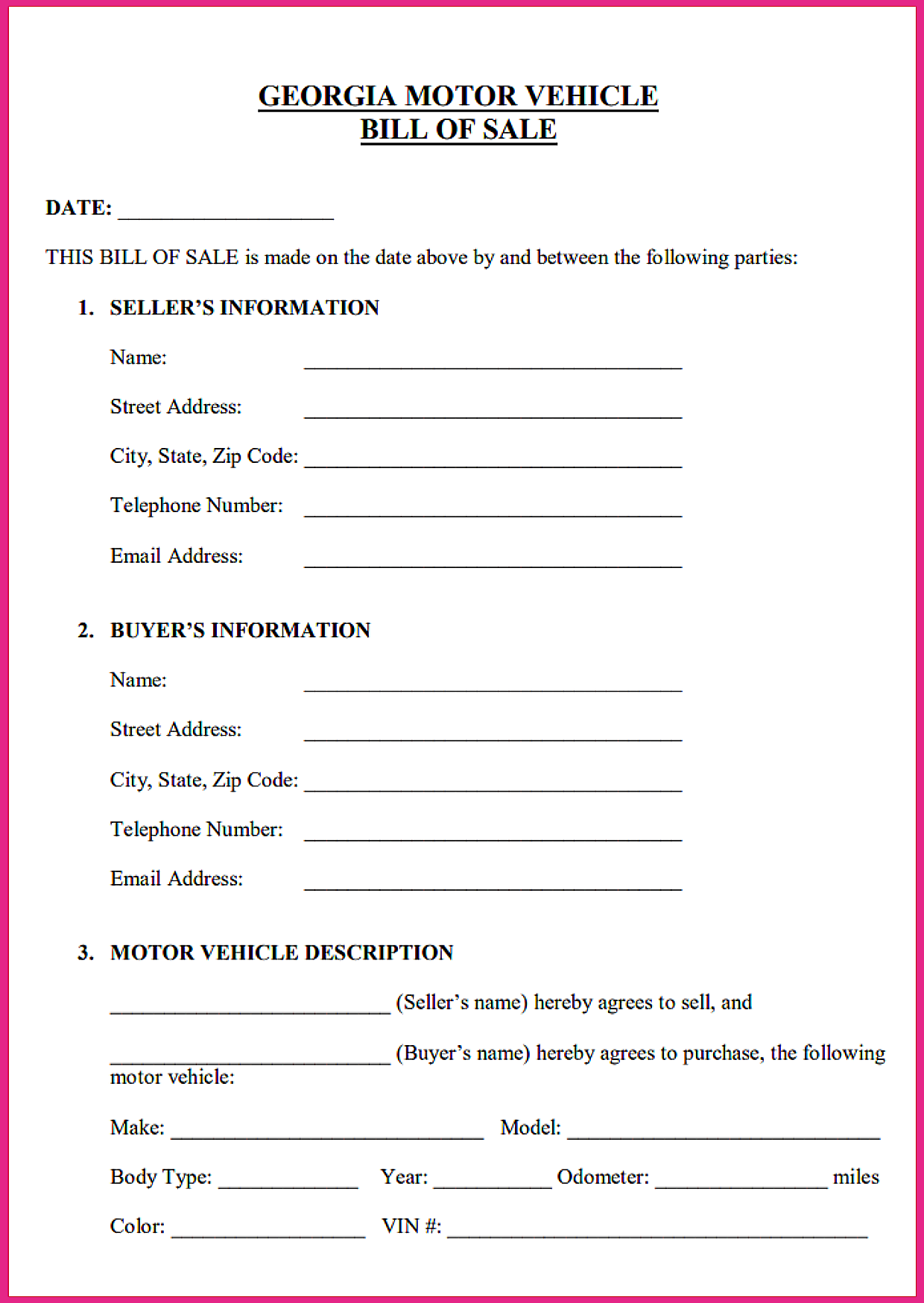
Whenever someone is dealing specifically with an auto sale, I emphasize the importance of an auto-focused bill of sale rather than a generic one. Cars come with extra layers of responsibility — from odometer readings to lien information — and using a form built for autos makes a big difference. I’ve seen deals derailed because a seller tried to use a general template and forgot something as basic as documenting the mileage. A clear auto bill of sale prevents that mess before it even starts.
One thing I personally like about a dedicated auto version is how neatly it organizes the information a Georgia DMV clerk wants to see. There’s no scrambling for details or guessing where something should go. And if you’re the type who wants a customizable version, I also make this available in multiple formats. Some folks download the editable Word file right away, while others stick with the cleaner, ready-to-print PDF — whatever gets the job done smoothly for you.
Blank Bill of Sale for Car Georgia
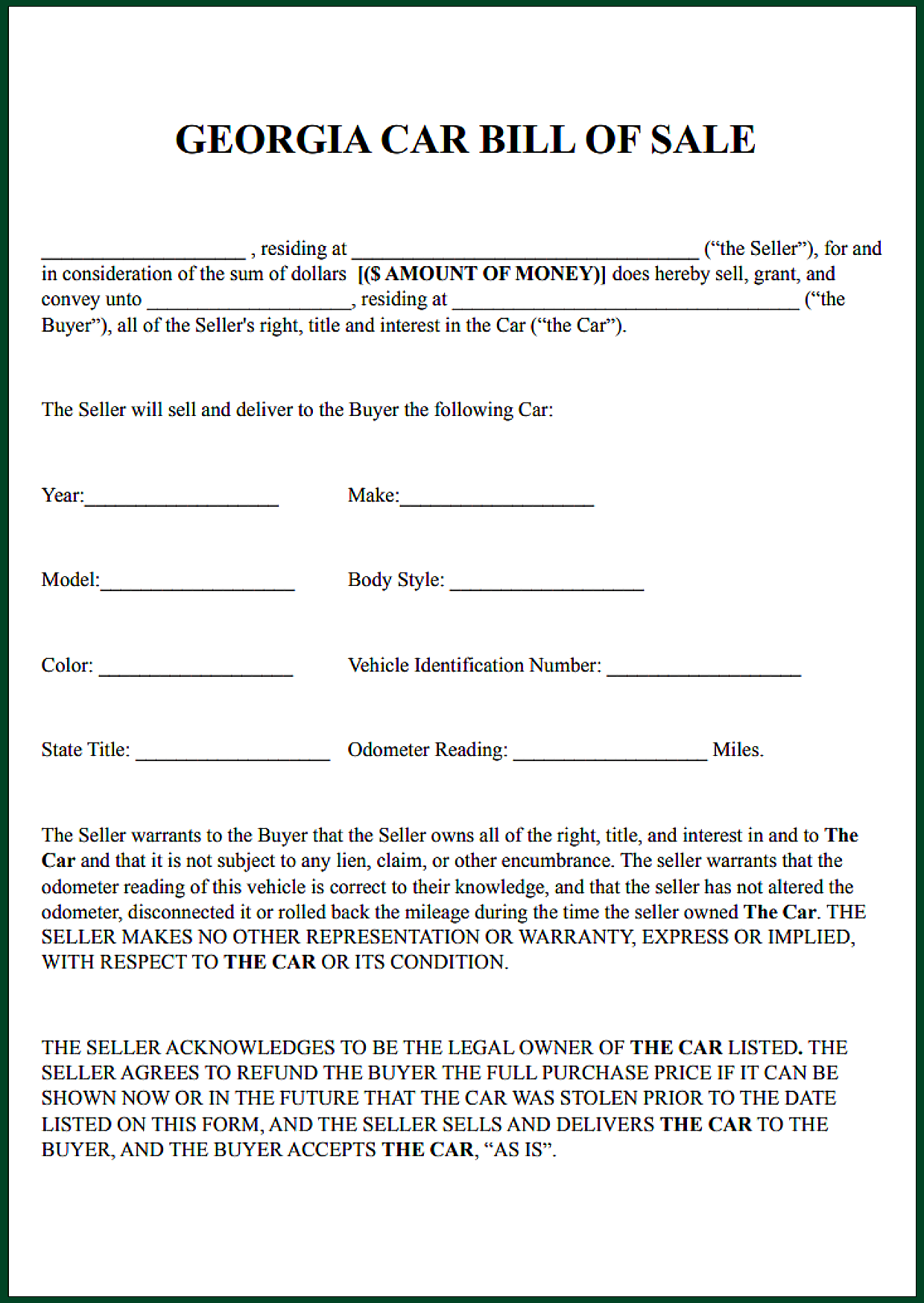
A Georgia car transaction has several details worth recording carefully. The VIN, sale date, purchase information, odometer information and lien information should match the transaction and the vehicle paperwork. Georgia’s Form T-7 is specifically designed to document a motor-vehicle transaction and includes fields for these details.
A car bill of sale can provide useful evidence of the transaction, but it does not replace Georgia’s title-transfer process or automatically resolve later tickets, title issues, or disputes. And because everyone works differently, I always offer the form in whichever format makes life easier. Some prefer the PDF for a quick print-sign-done process, while others like the flexibility of a Word version they can tweak before finalizing. Either way, you can download both versions and use whichever you’re more comfortable with.
Why a “Blank” Bill of Sale Matters More Than Folks Realize
A lot of people grab some random template online, fill in half of it, sign it, and call it a day. Personally, I wince when I see that. In my experience, a sloppily filled-out bill of sale is one of the top reasons deals fall apart at tag offices or, worse, lead to arguments months later.
I had a gentleman come in last year—nice guy, sold his truck to a neighbor. They used a bare-minimum bill of sale they printed off Facebook. Six months later, he started getting toll violation notices tied to that same truck. Turns out, the buyer never transferred the title, and because the bill of sale was incomplete, the state had no solid evidence of when the ownership changed. We fixed it, but it took hours of back-and-forth with the Georgia Department of Revenue.
That situation could’ve been avoided with a solid, complete bill of sale.
What a Proper Georgia Blank Bill of Sale Should Include
Now, Georgia doesn’t technically “require” a bill of sale in every situation, but I always tell people: treat it like it’s required. Because when something goes wrong, it becomes the most important page in your glove box.
Here’s what I always make sure is on a Georgia bill of sale—no shortcuts:
Full legal names and addresses of buyer and seller
(The DMV will absolutely question mismatched or partial names.)Exact date and time of sale
I’ve had cases where the time of sale affected liability.Detailed description of the property
For vehicles: year, make, model, body style, color, VIN.
For boats: HIN, length, motor details.
Don’t assume “silver Honda Civic” is enough—it isn’t.Odometer reading
For vehicles subject to odometer disclosure requirements, record the odometer reading accurately; vehicles 20 model years old or older are exempt from the current odometer disclosure requirements.Sale price and payment terms
Cash? Zelle? Payment plan? I’ve seen deals blow up because of vague payment notes.Signatures from both parties
Preferably with two signatures on every page if it’s more than one page.A simple “sold as-is” statement
It protects sellers from “You didn’t tell me about the transmission noise” claims.
You can start with Georgia’s Form T-7 when you’re documenting a vehicle transaction, but remember that it is a motor-vehicle bill of sale rather than a general form for every type of personal property. Just because the state accepts something doesn’t mean it’s the safest option for you.
When a Blank Template Needs More Than Blanks
One thing I see constantly: people try to keep things too simple. A blank bill of sale is a starting point, not the whole job. Depending on the situation, I might add:
A short statement confirming the seller is the lawful owner
A note that the buyer received the title (or will receive it on a specific date)
Clarification if there’s an existing lien
A clause about who handles tag and tax responsibilities
A quick line confirming the buyer inspected the property
A reference to any warranties or the lack thereof
Why do I add these? Because I’ve lived through the disputes that happen when these details are missing.
Common Georgia Pitfalls I See Every Month
I’ll give you some examples that still make me shake my head:
1. No VIN
People assume they’ll “fill it in later.” Please don’t. For a vehicle bill of sale, enter the VIN exactly as it appears on the vehicle and title when a VIN applies; Georgia’s Form T-7 specifically includes a field for the vehicle identification number.
2. Cash deals without receipts
If someone hands you $5,000 in cash and you don’t note it on the bill of sale… you’re gambling.
3. Stolen titles
Every few months, someone brings me a title the seller “forgot to sign.” If the bill of sale and the title don’t flow together neatly, Georgia’s DMV can freeze the process right there.
4. Handwritten corrections
On Georgia’s Form T-7, avoid corrections or alterations because the form states that any correction or alteration will void the form. The clerk will treat you like you forged a passport.
How I Usually Explain It to Clients
When reviewing a Georgia bill of sale, the practical question is whether the document clearly records what was sold, who sold it, who bought it, and the terms the parties actually agreed to.
“This sheet is your proof of what happened that day. If it ever goes in front of a judge or a DMV clerk who’s had a bad morning, will it hold up?”
Most people get the point instantly.
A bill of sale isn’t about paperwork. It’s about protection—yours. It’s the story of the deal, written clearly enough that no one can twist it later.
Disclaimer
None of this is formal legal advice for your unique situation—I don’t know the details yet. But it is the same sort of guidance I give friends, family, and half the folks who wander into my office worried about a sale gone wrong.
If you’ve got a specific situation, a messy sale, or you just want me to look over a bill of sale before you sign it, feel free to drop a comment, ask a question, or reach out. I’m always glad to help someone avoid the paperwork headaches I see every day.
FAQ
Do I really need a Blank Bill of Sale in Georgia if the title is already signed?
Not always. For a Georgia vehicle that requires a title, the properly assigned title is an important part of the ownership-transfer process. A bill of sale can provide additional evidence of the transaction, and Georgia specifically identifies a bill of sale for certain vehicles that do not require a title, including qualifying 1985-or-older vehicles.
Can I use any online Blank Bill of Sale Georgia template?
Technically you can, but I don’t recommend grabbing whatever pops up on Google. Georgia’s DMV clerks are surprisingly strict about missing information. I’ve seen deals rejected over something as small as a missing VIN or unclear odometer reading. I always prefer starting with Georgia’s Form T-7 and then adding the extra details that real-life situations usually require.
Is a handwritten bill of sale valid in Georgia?
It can be — but here’s the problem: handwritten bills often turn into a mess. Scribbled numbers, scratched-out corrections, and unclear signatures raise red flags fast. I’ve seen clerks reject perfectly legitimate sales just because the document “looked suspicious.” If you must write it by hand, keep it clean and complete. Personally, I strongly prefer a typed bill of sale.
Does a Blank Bill of Sale Georgia protect me if the buyer never registers the vehicle?
A bill of sale can help document when a vehicle transaction occurred, but the buyer remains responsible for completing the required title and registration steps with the County Tag Office.
Legal Disclaimer: This article provides general information about Georgia bills of sale and is not legal advice. Laws and requirements may change, and specific transactions may have additional requirements. For advice about your particular situation, consult a qualified Georgia attorney or the appropriate government agency.