
For Motor Vehicle | Auto | Car | Trailer | Printable | PDF | Form | Boat | Blank | Used Car | Private Car | Vessel
“Most people don’t think a bill of sale matters… until it suddenly matters a lot.”
And that’s exactly why a Bill of Sale Georgia isn’t just a casual piece of paperwork. It’s a legal record that protects both the buyer and the seller when ownership changes hands. In Georgia, this single document often becomes the first thing the DMV looks at, the first question a buyer asks later, and sometimes the only proof that a sale actually happened.
I’ve spent years practicing law right here in Georgia, dealing with real bill of sale disputes, vehicle transfers gone wrong, title problems, and private-party sales that spiraled into legal messes. I’ve seen how a properly written bill of sale can quietly save someone from fines, liability, or court — and how a poorly written or missing one can do the exact opposite.
So instead of legal theory or generic advice, I want to explain this the same way I do with my own clients: plainly, honestly, and based on what actually happens in Georgia — not what people think happens.
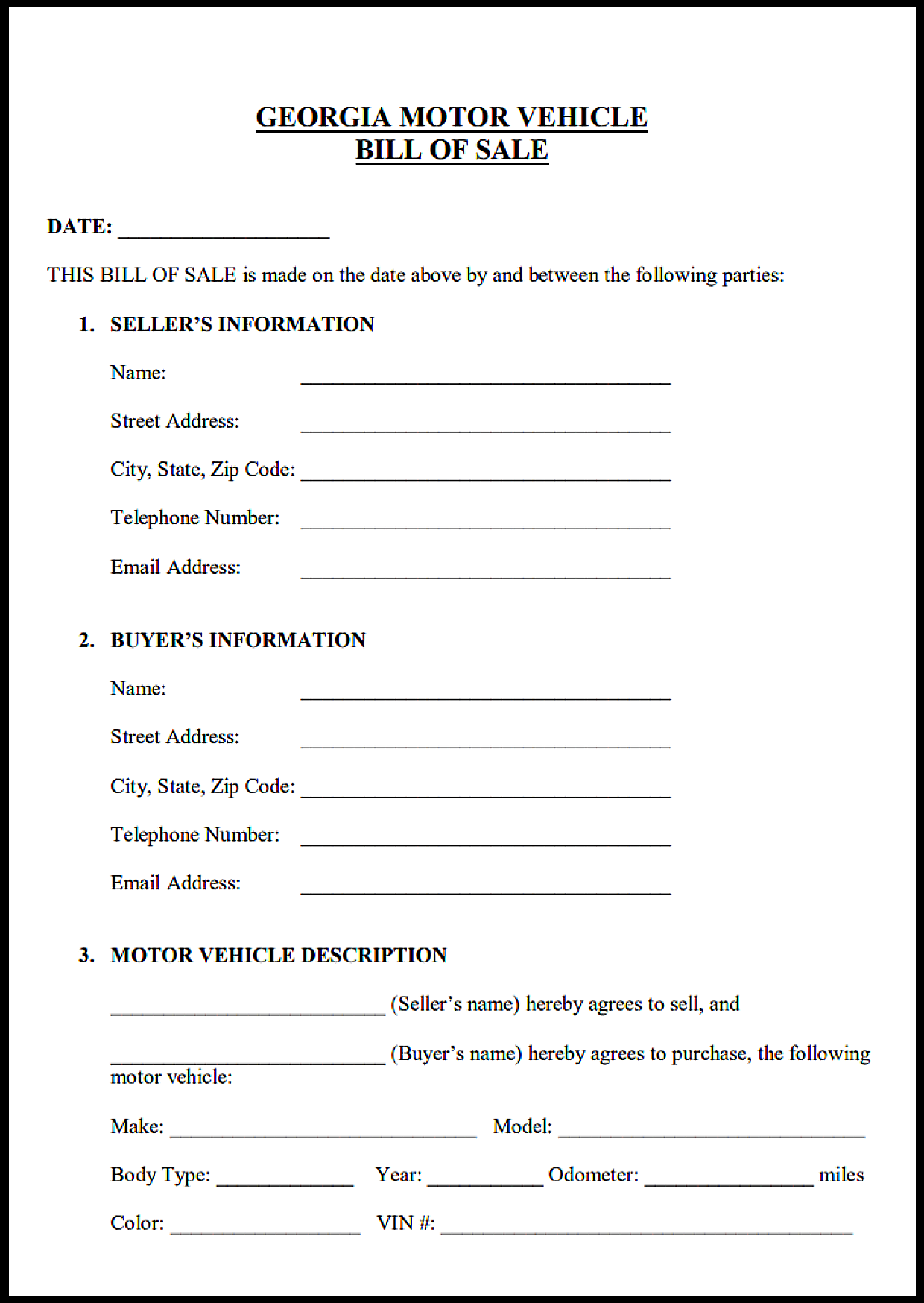
Free Bill Of Sale Georgia Templates
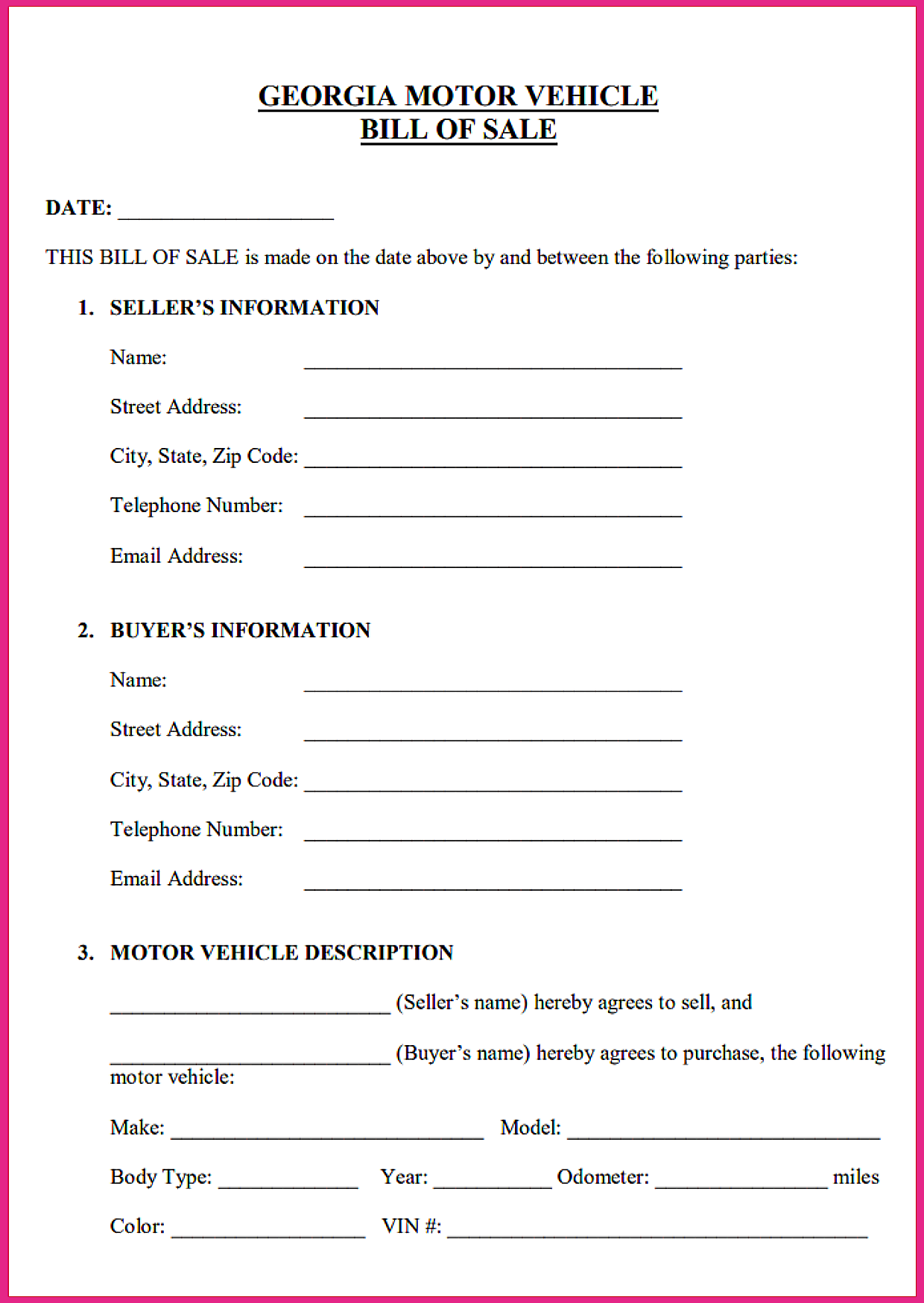
When people ask me about Free Bill Of Sale Georgia templates, it’s usually because they want something reliable without overcomplicating the process. And honestly, I get that. Over the years, I’ve seen plenty of clients grab random templates online, only to find out later they didn’t quite fit Georgia’s real-world requirements. A good Georgia-specific template should clearly reflect the buyer, seller, item details, sale date, and signatures—nothing fancy, just accurate and complete.
In my experience, using the right template can quietly prevent a lot of trouble with the DMV, future disputes, or questions about when ownership actually transferred. That’s why I always recommend starting with a template designed for Georgia transactions, not a generic one meant for “any state.” For convenience, I’ve included PDF and Word format versions for all the templates mentioned above, so you can easily download, fill them out, and keep copies for your records. Having access to both formats makes it easier to use what works best for you—whether you want something quick to print or easy to edit.
Georgia Motor Vehicle Bill of Sale
When a vehicle changes hands in Georgia, two things need to happen: the title gets signed over, and the transaction gets documented. The Georgia motor vehicle bill of sale handles the second part. It records the sale price, the date, the vehicle details, and both parties’ information. I’ve seen sellers get contacted months after a sale about parking tickets and liability issues because the buyer never registered the vehicle. Without a dated, signed bill of sale, proving when responsibility transferred is a lot harder than it should be.
Georgia Auto Bill of Sale
Private car sales move fast in Georgia, and that speed is exactly when documentation gets skipped. Someone agrees on a price, cash changes hands, and both parties assume everything is fine. Usually it is. But when it isn’t — when the sale price becomes disputed for TAVT purposes, or a buyer claims the terms were different — the Georgia auto bill of sale is the document that ends the argument. Fill it out before the money changes hands, have both parties sign on the spot, and keep a copy.
Georgia Bill of Sale for Car
The details that matter most in a passenger car sale are the ones people skip when they’re in a hurry. The VIN copied directly from the dashboard, not from memory. The actual odometer reading on the day of sale. The Georgia bill of sale for car is structured around exactly these fields. If the VIN on the document doesn’t match the title, the tag office clerk sends you home. Getting it right the first time takes five minutes. Fixing it after the fact can take weeks.
Automobile Bill of Sale Georgia
Georgia’s Title Ad Valorem Tax is calculated based on the vehicle’s fair market value or the documented sale price, whichever is higher. When a buyer shows up at the tag office with an accurately completed automobile bill of sale showing the real purchase price, they have their strongest argument against an inflated TAVT assessment. For sellers, it documents the precise date ownership transferred — which matters if a traffic violation or accident happens after the sale but before the buyer registers the vehicle.
Georgia Private Car Bill of Sale
When a dealer is involved, they handle the title application and the compliance paperwork. In a private sale, all of that falls on the buyer and seller to manage themselves. The Georgia private car bill of sale gives both parties a structured record of what was agreed — price, vehicle condition, as-is terms, date of transfer. Most Georgia vehicle disputes I’ve seen over the years started with a private sale where one or both parties skipped the paperwork.
Used Car Bill of Sale Georgia
Used vehicle sales carry more risk than new ones by nature. Buyers worry about undisclosed mechanical issues. Sellers worry about being contacted after the sale about problems they didn’t cause. A used car bill of sale in Georgia with a clear as-is clause documents what was known and disclosed at the time of sale. It limits liability for the seller and creates a record of what the buyer accepted. In used car transactions, this document is the difference between a clean sale and an ugly phone call six months later.
Gifted Car Bill of Sale Georgia
Transferring a vehicle as a gift is common in Georgia — parents to children, between siblings, grandparents passing a car down. But a gift still requires documentation. A gifted car bill of sale in Georgia records the transfer with a stated value of $0 or $1 and identifies the relationship between the parties. That relationship matters because Georgia offers TAVT exemptions for qualifying family transfers under Form MV-16. Without the right paperwork, the recipient ends up paying full TAVT on fair market value — a tax bill proper documentation would have avoided entirely.
Motorcycle Bill of Sale Georgia
Any motorcycle manufactured in 1986 or later requires a title transfer in Georgia, the same as any other motor vehicle. The motorcycle bill of sale in Georgia works alongside that title — documenting the agreed sale price, the odometer reading, and the specific bike details a title alone doesn’t capture. A signed bill of sale with an as-is clause is what protects the seller when a buyer calls three weeks later claiming a problem was never mentioned.
Trailer Bill of Sale Georgia
Trailers get bought and sold in Georgia all the time without any paperwork, and most of the time nothing goes wrong. The problem surfaces later, when the buyer tries to resell or register the trailer and has nothing proving they ever owned it. A trailer bill of sale in Georgia costs nothing to complete and takes about ten minutes. For trailers over 2,000 pounds, Georgia requires a title alongside this document. For lighter trailers, it may be the primary proof of ownership you have.
ATV Bill of Sale Georgia
ATVs are a fixture across rural Georgia — on farms, hunting land, and private property throughout the state. They change hands regularly, often with a handshake and no paperwork. That absence becomes a real problem when the buyer tries to resell or register the ATV and has nothing to show for how they acquired it. An ATV bill of sale in Georgia records the machine’s details, the agreed price, and the transfer date — and supports the registration application at the tag office.
Camper Bill of Sale Georgia
Campers and RVs represent some of the higher-value private transactions in Georgia, and higher value means the stakes are higher if something goes wrong after the sale. A camper bill of sale in Georgia records the make, model, year, VIN, and sale terms clearly. For titled campers, this document travels alongside the signed title — not in place of it. Both need to be completed and kept by both parties.
Mobile Home Bill of Sale Georgia
Mobile home transactions in Georgia sit in their own category. Depending on how the home is classified, the documentation requirements and agencies involved can differ significantly from a vehicle sale. A mobile home bill of sale in Georgia records the property’s identifying details, the agreed price, any conditions of the sale, and both party signatures. These transfers often run through county tax records rather than the DOR. Getting this paperwork right prevents ownership complications that can take months to untangle.
Bill of Sale for Firearm in Georgia
Georgia doesn’t require a background check for most private firearm transfers, but that doesn’t make documentation optional. A bill of sale for a firearm in Georgia creates a written record of when the transfer occurred, who the parties were, and what was sold. If the firearm is later reported stolen, used in a crime, or becomes the subject of a dispute, that documentation is the seller’s evidence that ownership changed hands at a specific point in time.
Generic Bill of Sale Georgia
Sometimes a sale doesn’t fit neatly into a vehicle, boat, or specific property category. Equipment, tools, personal items — things that change hands without a government-issued title. A generic Georgia bill of sale works for exactly those situations. It provides the core structure — seller, buyer, item description, price, date, signatures — without being tied to one asset type. Legal weight comes from accuracy and completeness, not from using a specialized form.
Georgia Boat Bill of Sale
Boat transactions in Georgia run through the Department of Natural Resources, not the DOR — which means different requirements than a standard vehicle sale. The Georgia boat bill of sale captures what DNR registration needs: hull identification number, vessel type, engine details, length, and the terms of the sale. Whether you’re selling a fishing boat on Lake Lanier or a pontoon on Lake Hartwell, getting this paperwork right at the time of sale prevents the registration delays that are frustratingly common when buyers show up without the right documentation.
Georgia Vessel Bill of Sale
A Georgia vessel bill of sale applies to boats and watercraft of all kinds — motorboats, sailboats, personal watercraft, pontoons. It records the hull identification number, vessel type, and sale terms in a format that supports DNR registration and ownership transfer. Vessel sales that happen without proper paperwork frequently stall at the registration stage, leaving a buyer sitting on an asset they can’t legally put on the water. Ten minutes of documentation at the time of sale prevents weeks of follow-up afterward.
Printable Bill of Sale Georgia
Sometimes the deal happens today and there’s no time to source paperwork elsewhere. A printable Georgia bill of sale downloads instantly, prints cleanly, and gives you a legally usable document you can complete by hand on the spot. Blue or black ink, no white-out for corrections, two copies printed so both parties leave with one. Before anyone drives away, photograph both signed originals. That thirty-second step has settled more disputes than people expect.
Vehicle Bill of Sale Georgia PDF
Some people prefer a form they can open on any device, complete cleanly on screen, and print without the layout shifting. The vehicle bill of sale Georgia PDF holds its formatting regardless of what printer or device opens it — which matters when the document ends up in front of a tag office clerk or gets referenced in a dispute. Fill it digitally, print two copies at time of sale, and store a digital backup somewhere you’ll actually find it later.
Blank Bill of Sale Georgia
Not every transaction fits a standard template neatly. A blank Georgia bill of sale gives you a clean structure to work from and fill in based on your specific deal. Every field still matters — a missing VIN, an unsigned line, or an undated document reduces the form’s usefulness significantly. Print two copies, have both parties sign before anyone leaves, and keep one each.
Sample Bill of Sale Georgia
If you’ve never completed a bill of sale before, seeing a finished example is the fastest way to understand what’s actually required. A sample Georgia bill of sale shows every field filled in correctly — the way a tag office or attorney would expect to see it. First-time sellers consistently make the same mistakes: leaving the odometer field blank, signing with a nickname, forgetting to date the document. A completed sample eliminates all of those before you start.
Georgia Bill of Sale Form
The reason a structured form is better than a handwritten note is simple: it prompts you through every field before you finish. Sale price, VIN, odometer reading, both parties’ full legal names, signatures, date. The Georgia bill of sale form makes sure nothing gets overlooked in the rush to close the deal. I’ve reviewed plenty of handwritten sale records, and the missing fields are almost always the ones that would have mattered most in the dispute that followed.
Georgia DMV Bill of Sale
The Georgia DOR’s T-7 is the official bill of sale form used at county tag offices across the state. Clerks process private sale transactions using this format every day, and they know immediately when something is missing or doesn’t match. Using the Georgia DMV bill of sale means fewer questions at the counter, fewer requests to come back with corrected paperwork, and a smoother registration process overall.
Simple Bill of Sale Georgia
Not every transaction needs an extensive document. For straightforward sales where both parties know each other and the deal is clear-cut, a simple Georgia bill of sale covers what actually matters: who sold what, to whom, for how much, on what date, with both signatures. Simple doesn’t mean careless, though. Every field needs to be accurate. A simple form completed carefully is more useful in a dispute than a detailed one done in a hurry with missing information.
General Bill of Sale Georgia
Most everyday private sales in Georgia go smoothly. But occasionally a buyer claims the price was different, or a seller gets contacted about something they sold months ago. A general Georgia bill of sale creates a permanent record that makes those situations much shorter to resolve. It works for vehicles, personal property, equipment, and general assets of all kinds. For any sale worth more than a few hundred dollars, the five minutes it takes to complete is the most practical thing either party can do.
What a Free Bill of Sale Really Does in Georgia
In my experience, a bill of sale isn’t about paperwork for paperwork’s sake. It’s about proof.
In Georgia, a bill of sale helps establish:
- Who sold the item
- Who bought it
- What was sold
- When the transfer actually happened
- And for how much
I’ve seen cases where someone sold a car, didn’t do a proper bill of sale, and months later got hit with parking tickets, toll violations, or even liability issues—because the state still showed the vehicle tied to their name.
That’s not theoretical. That’s real life.
When Georgia Actually Requires a Bill of Sale
Here’s where people get confused—and honestly, I don’t blame them.
Georgia does not always require a bill of sale for every transaction. But here’s what I’ve learned over the years:
- Private vehicle sales: Not always required, but strongly recommended
- Vehicles without titles (older models): Bill of sale becomes critical
- Trailers, boats, ATVs: Often required by the county or lender
- Out-of-state transfers: Almost always requested
- Disputes later on: A bill of sale can be the only thing that saves you
Personally, I strongly prefer having one every single time, even if the clerk at the counter says, “You don’t really need it.”
Clerks change. Problems show up later.
What a Georgia Bill of Sale Must Include (This Matters)
I’ve reviewed hundreds of “free templates” people found online. Some are fine. Many are missing key details that cause issues later.
In Georgia, a solid bill of sale should clearly include:
- Full legal names of buyer and seller
- Physical addresses (not just emails or phone numbers)
- Description of the item (VIN for vehicles, serial numbers if applicable)
- Sale price (even if it’s $1 or a gift)
- Date of sale
- Signatures of both parties
I always recommend writing the sale price honestly. I’ve seen undervalued prices trigger tax questions at the DMV—and that’s never a fun conversation.
The DMV Reality Most People Don’t Expect
Here’s a moment I’ve seen play out more times than I can count:
A client walks into the Georgia Department of Revenue office feeling confident… and walks out frustrated.
Why?
Because:
- The bill of sale didn’t match the title
- The date was missing
- The VIN had one wrong digit
- Or the seller never signed
The DMV isn’t being difficult—they’re protecting the record. But they won’t fix your mistakes for you.
What I’ve learned is this: clarity now prevents rejection later.
Common Georgia Mistakes I See (Over and Over)
Let me save you from the same problems I see weekly:
- Using a generic form that isn’t Georgia-friendly
- Forgetting the sale date
- Leaving out VINs or serial numbers
- Not keeping a copy for yourself
- Assuming a text message counts as proof
I once handled a dispute where both parties remembered the sale differently. Guess who won? The person with the signed bill of sale.
Memory fades. Paper doesn’t.
Do You Need It Notarized in Georgia?
Short answer: Usually no.
Longer answer, from experience:
- Most Georgia bills of sale do not require notarization
- Some counties or lenders may request it
- Notarization can add extra protection in disputes
If you ask me personally? If it’s a high-value sale or someone you don’t know well, I don’t mind spending five extra minutes getting it notarized. It’s cheap insurance.
My Practical Advice Before You Walk Away From the Sale
Before you hand over keys, cash, or property, I always tell clients to pause and ask:
- Is everything written clearly?
- Do both parties have copies?
- Does this reflect what actually happened?
Because once you leave, fixing mistakes gets harder—and sometimes expensive.

About Dale Preiser
Author
Dale Preiser is the Assistant Director of Legal Services at the Southern States Police Benevolent Association, where he provides legal support and counsel for law enforcement professionals facing job-related legal issues. With a strong foundation in law and public service, Dale brings years of experience working across legal and professional sectors, including law enforcement and healthcare industries. He holds a Juris Doctor degree from Oklahoma City University and previously ran a private law practice in McDonough, Georgia before joining SSPBA in 2012. Dale is also the voice behind Bill of Sale Georgia, a dedicated resource on bill of sale forms and legal documentation for Georgia residents and businesses. His commitment to legal clarity and member advocacy underscores his contributions to both the website and the law enforcement community.
A Quick, Honest Legal Note
This is general Georgia guidance based on what I’ve seen in real cases—not a substitute for personal legal advice. Every situation has its quirks. If something feels off, trust that instinct and ask a professional before signing.
Final Thoughts — From One Georgian to Another
I’ve seen a free bill of sale protect honest people more times than I can count. It doesn’t have to be fancy. It just has to be clear, accurate, and signed.
If you’ve got questions, a strange situation, or a deal that feels a little messy—drop a comment, reach out, or stop by my office. I’ve probably seen something similar before, and I’m always happy to talk it through.
That’s how problems get avoided in Georgia—one good conversation at a time.
FAQ
This is one of the first questions clients ask me, and the honest answer is: sometimes yes, sometimes no—but practically, almost always. Georgia law doesn’t require a bill of sale for every transaction, especially if the vehicle already has a valid title. That said, I’ve seen too many cases where the absence of a bill of sale caused serious problems later.
In real life, the Georgia Department of Revenue, county tag offices, lenders, and even courts often rely on a bill of sale to confirm when ownership changed. Personally, I always recommend using one—even when it’s not strictly required—because it creates a clear paper trail if questions come up months or years later.
Yes, you can—and many of my clients do. A Free Bill Of Sale Georgia template is perfectly acceptable as long as it’s done correctly. The problem I see isn’t the word “free”; it’s incomplete or sloppy forms.
In my experience, free templates cause issues when they’re missing key details like VIN numbers, full names, addresses, or signatures. If you’re going to use a free form, make sure it clearly reflects the actual transaction. A poorly filled-out bill of sale can be worse than none at all, because it creates confusion instead of clarity.
This is usually when the tone in my office gets serious. Without a bill of sale, you may have no proof of when the sale happened—or that it happened at all. I’ve represented sellers who kept getting toll bills, tickets, or tax notices because the buyer never transferred the title properly.
In Georgia, a bill of sale can protect you from liability after the sale date. Without it, you’re relying on memory, goodwill, and luck. In my professional opinion, that’s not a smart position to be in—especially when a simple document could have prevented the problem.
Yes, a handwritten bill of sale can be valid in Georgia, and I’ve seen plenty of them hold up just fine. Georgia law doesn’t require a specific format or typed document. What matters is whether the bill of sale clearly shows who sold the item, who bought it, what was sold, the date of sale, and that both parties signed it.
That said, in my experience, handwritten bills of sale are more likely to cause problems later—not because they’re illegal, but because they’re often incomplete or hard to read. If you go this route, write clearly and include all essential details. Personally, I still prefer a clean template because it reduces mistakes and avoids confusion with the DMV or tax office down the line.
Most of the time, no—notarization is not required under Georgia law. That said, I’ve learned over the years that “not required” doesn’t always mean “not helpful.”
If the sale involves a high-value vehicle, a trailer, a boat, or someone you don’t know well, notarizing the bill of sale adds an extra layer of protection. I’ve seen disputes where one party claimed the signature wasn’t theirs—and a notary stamp would’ve ended the argument immediately. For a few extra minutes, it can be worth it.