Why the Vessel Bill of Sale Matters More Than People Think
In Georgia, boats are regulated through the Department of Natural Resources (DNR), not the DMV like cars. That alone throws people off. I’ve had clients bring me a perfectly filled-out car bill of sale and assume it works for a boat. It doesn’t.
A vessel bill of sale is your proof of ownership transfer. It’s what the DNR looks at when you’re registering the boat, and it’s what protects you if questions come up later—tax issues, ownership disputes, or even liability problems.
I’ve seen situations where a buyer couldn’t register their boat for months because the bill of sale was missing one small detail. Meanwhile, the boat sat unused, and the frustration kept growing. All of that over a form that could’ve been done right the first time.
Georgia Vessel Transfer Laws That Create Problems When Ignored
| Topic / Issue | Georgia Legal Rule | Governing Statute |
|---|
| Jurisdiction & Controlling Law | Vessel ownership transfers, titling, and registration in Georgia are regulated under O.C.G.A. Title 52, Chapter 7 and administered by the Georgia Department of Natural Resources (DNR) Wildlife Resources Division. Commercial warranty issues are additionally governed by Georgia’s UCC sales laws. | O.C.G.A. Title 52, Chapter 7 |
| Execution Formalities (Witnesses) | No statutory requirement exists for third-party witnesses on a private vessel bill of sale, although both buyer and seller must sign the document for DNR processing purposes. | No statutory requirement; governed by general contract law. |
| Notary Public Requirements | A Georgia vessel bill of sale does not require notarization to be legally valid between the parties or accepted by DNR. | No statutory requirement; governed by general contract law. |
| Outboard Motor Inclusion Mandate | Any outboard motor greater than 25 horsepower used with a titled vessel must be specifically itemized on transfer paperwork and title applications. | O.C.G.A. § 52-7-4(b) |
| Registration & Title Application Window | Buyers must apply for vessel registration transfer and certificate of title within 30 days of purchase to remain compliant and preserve temporary operating authority. | O.C.G.A. § 52-7-4 and O.C.G.A. § 52-7-5 |
| Age and Capacity Requirements | Individuals under 18 years old lack full legal capacity to execute binding property transfers, making a vessel bill of sale voidable at the minor’s discretion. | O.C.G.A. § 39-1-1 |
| “Hull Damaged” Structural Disclosure Brand | Sellers must explicitly disclose “Hull Damaged” status on the transfer document if the vessel sustained structural hull damage during ownership. | O.C.G.A. § 52-7-4(c)(2) |
| Conspicuous “AS IS” Warranty Disclaimers | To legally waive implied warranties, the bill of sale must contain conspicuous language such as “AS IS” or “WITH ALL FAULTS.” | O.C.G.A. § 11-2-316(3)(a) |
| Hull Identification Number (HIN) Itemization | Every vessel manufactured after 1972 must display and document its 12-character Hull Identification Number on the bill of sale and transfer paperwork. | O.C.G.A. § 52-7-7.1 |
| Filing & Registration Requirements | Vessel bills of sale must be filed directly with Georgia DNR Wildlife Resources Division together with registration applications, prior ownership records, and statutory fees. | O.C.G.A. Title 52, Chapter 7 |
| Criminal Penalty for Counterfeit or Defaced HINs | It is a felony offense to knowingly buy, sell, possess, or transfer a vessel or motor with a removed, altered, or defaced Hull Identification Number. | O.C.G.A. § 52-7-7.5 |
| Civil Liability for “Hull Damaged” Non-Disclosure | Sellers who fail to disclose known “Hull Damaged” status may face administrative civil penalties up to $5,000. | O.C.G.A. § 52-7-4(f) |
| Prohibition Against Operating an Unregistered/Untitled Vessel | A private bill of sale alone does not provide indefinite operating rights. Operating an unregistered or untitled vessel beyond the temporary grace period is a criminal misdemeanor. | O.C.G.A. § 52-7-4(a)-(b) |
One of the biggest surprises for Georgia boat buyers is how seriously the state treats Hull Identification Numbers. I’ve seen vessel transfers completely stall because one HIN digit didn’t match the paperwork or because an older boat had a damaged serial plate. Georgia law goes even further by making it a felony to knowingly transfer a vessel with an altered or defaced HIN, which is far more serious than most private sellers realize.
The “Hull Damaged” disclosure rule also matters more than people expect. If a seller knows the hull suffered major structural damage and fails to disclose it properly, Georgia can impose civil penalties reaching thousands of dollars. I’ve seen buyers discover hidden collision or grounding damage months after the sale, and that situation becomes extremely expensive very quickly.
Another common issue involves the 30-day registration deadline. A signed bill of sale does not give unlimited operating rights on Georgia waters. Missing the registration window can expose buyers to misdemeanor problems and unnecessary DNR headaches.
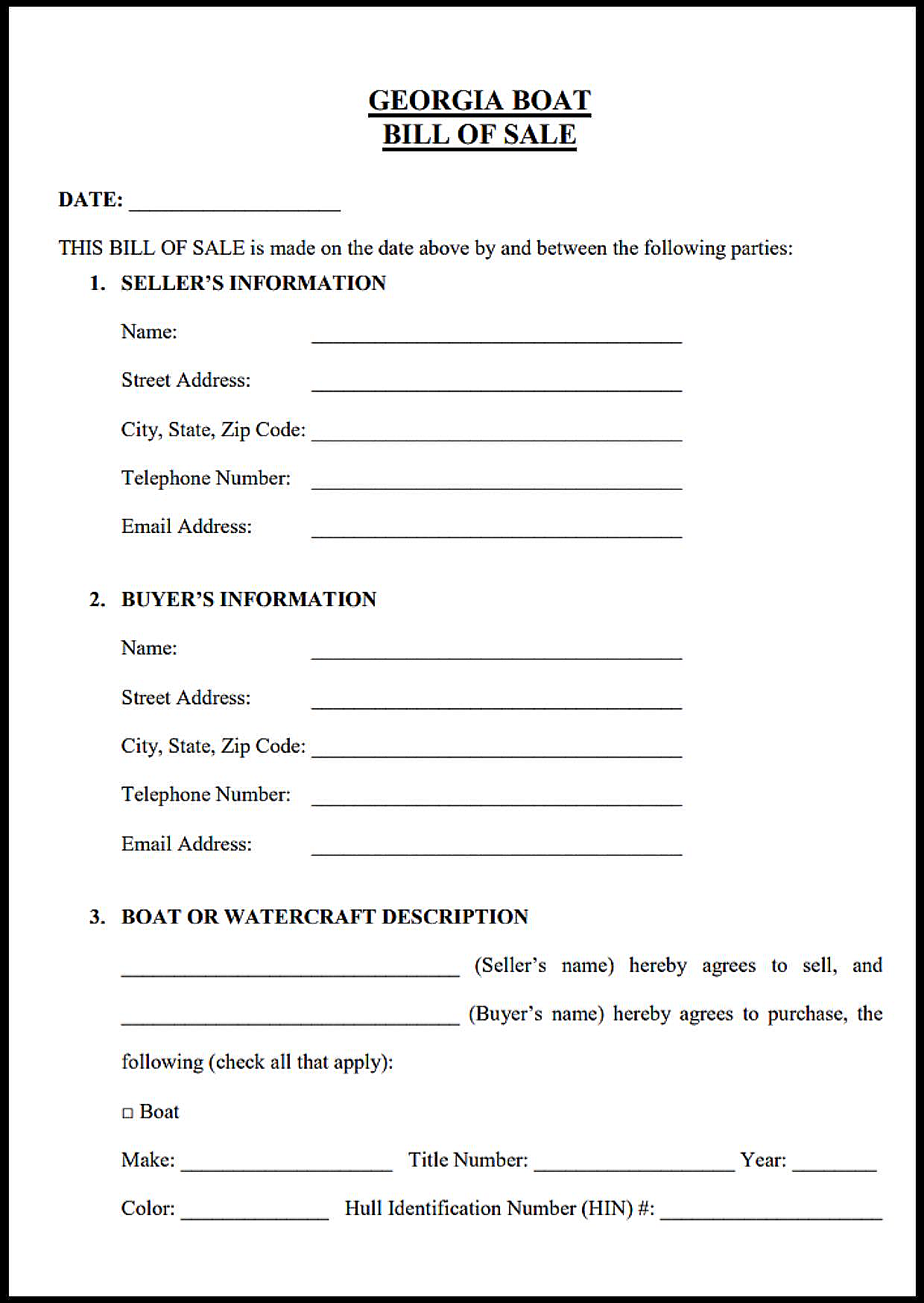
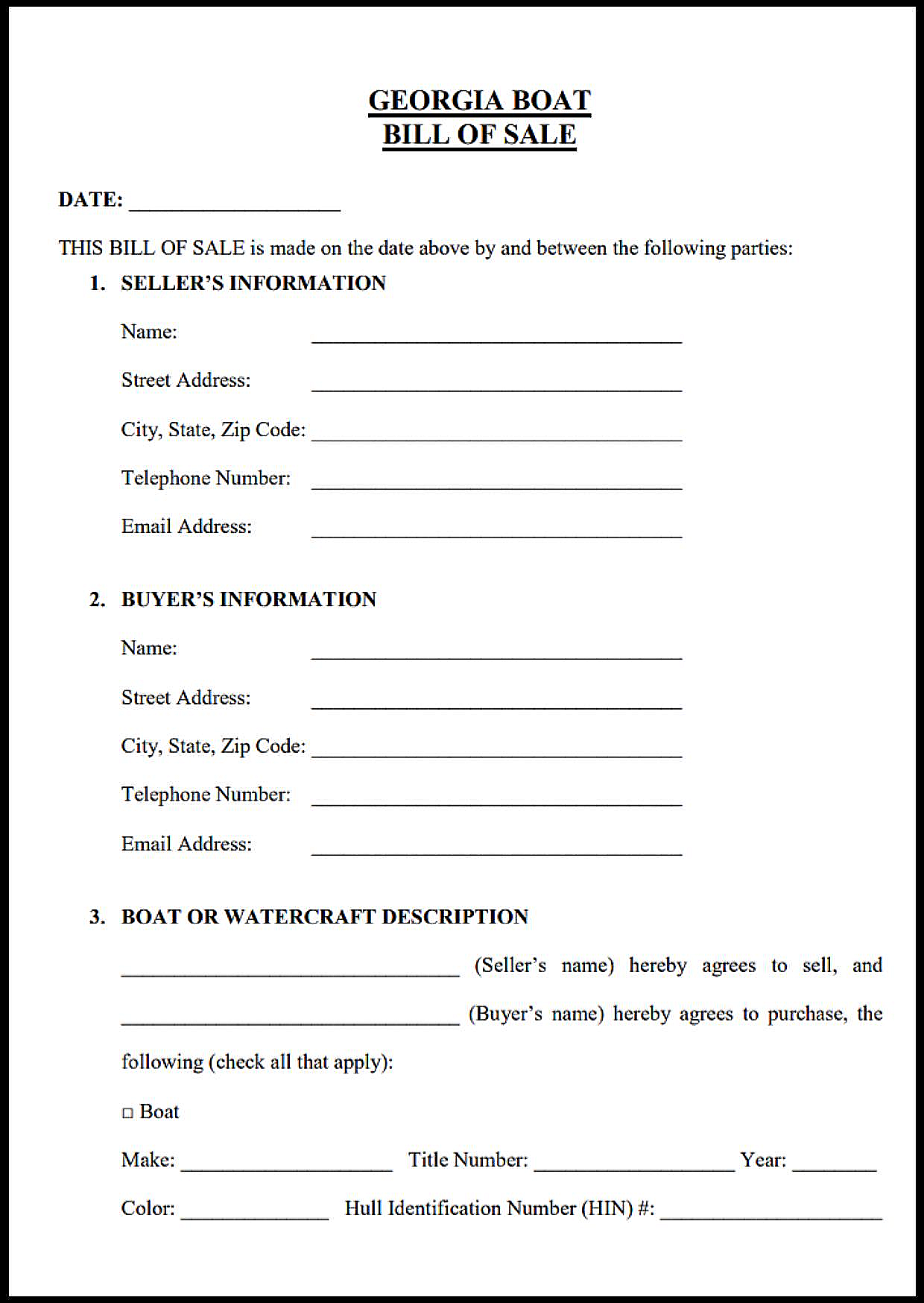
To avoid registration delays and ownership disputes, download the free Georgia Vessel Bill of Sale template below and complete it carefully before finalizing your boat sale.
What Georgia Actually Expects on a Vessel Bill of Sale
Georgia doesn’t require a single “official” bill of sale form for vessels the way it does for some vehicles, but don’t let that fool you into thinking anything scribbled on paper will do.
In my experience, a solid Georgia vessel bill of sale should clearly include:
Full legal names and addresses of buyer and seller
Date of sale (not the date you plan to file paperwork—actual sale date matters)
Purchase price and payment terms
Complete vessel description (make, year, length, hull material)
Hull Identification Number (HIN) — this is non-negotiable
Information about the outboard motor, if sold with the boat
Trailer details, if included (this is where people often forget things)
Signatures from both parties
Personally, I always recommend typing it out or using a clean printable template. Handwritten bills of sale aren’t illegal, but they’re harder to read, easier to dispute, and more likely to cause delays with DNR processing.
The Most Common Mistakes I See (Over and Over)
If I had a dollar for every time I saw these issues, I’d be retired and fishing full-time by now.
Missing or incorrect HIN
One wrong digit can stop a registration cold. I’ve seen boats sold with a copied HIN from old paperwork that didn’t match the hull itself.
Forgetting the trailer
People assume the trailer “comes with the boat.” Legally, it doesn’t unless it’s listed. Trailers may require their own bill of sale or title depending on weight.
No lien check
I once helped a buyer who learned—after paying in full—that the boat still had a lien from a marine lender. That was an uncomfortable conversation.
Casual wording
Phrases like “sold as is” are fine, but vague language about condition or ownership can open the door to disputes later. Clear is always better than casual.
Registration with Georgia DNR: Where the Bill of Sale Comes In
After the sale, the buyer must register the vessel with Georgia DNR. The bill of sale is one of the primary documents they’ll review. If it doesn’t line up with the application or supporting documents, it gets kicked back.
I’ve watched clients lose weeks because of something as simple as mismatched dates or missing signatures. The DNR isn’t trying to be difficult—they’re trying to make sure ownership is legitimate. And honestly, that protects everyone involved.
My Personal Advice to Buyers and Sellers
Here’s what I tell people sitting right across from me:
Don’t rush the paperwork just because the deal feels friendly
Make copies of everything immediately
Double-check the HIN on the boat itself
Include motor and trailer details even if you think they’re “obvious”
Sign the bill of sale the same day money changes hands
If you’re selling, I strongly prefer adding language that clearly states the vessel is sold free of liens (if that’s true). If you’re buying, don’t be shy about asking for proof.
A Quick Legal Note
I’ll say this the way I usually do in my office: I’m sharing real experience, not creating an attorney-client relationship in a blog post. If something feels off about a sale—or a deal already went sideways—talk to a Georgia attorney who works with vessel transactions. Catching problems early is always cheaper than fixing them later.
Final Thoughts from Someone Who’s Seen It All
Boats are supposed to bring freedom, not stress. Most of the vessel-related legal problems I see in Georgia could’ve been avoided with a properly written bill of sale and a little patience.
If you’re unsure, slow down. Ask questions. Do it right once.
And if you’ve got a situation you’re worried about—or just want a second set of eyes on your paperwork—you’re welcome to reach out. Drop a comment, ask a question, or contact my office. I’ve probably seen something similar before, and I’m always happy to help steer people in the right direction.